Evidence-Based Workforce Decisions
This guide shows how Avelin supports workforce decisions with inspectable evidence.
It is useful when a workforce choice is important enough to require traceability before action.
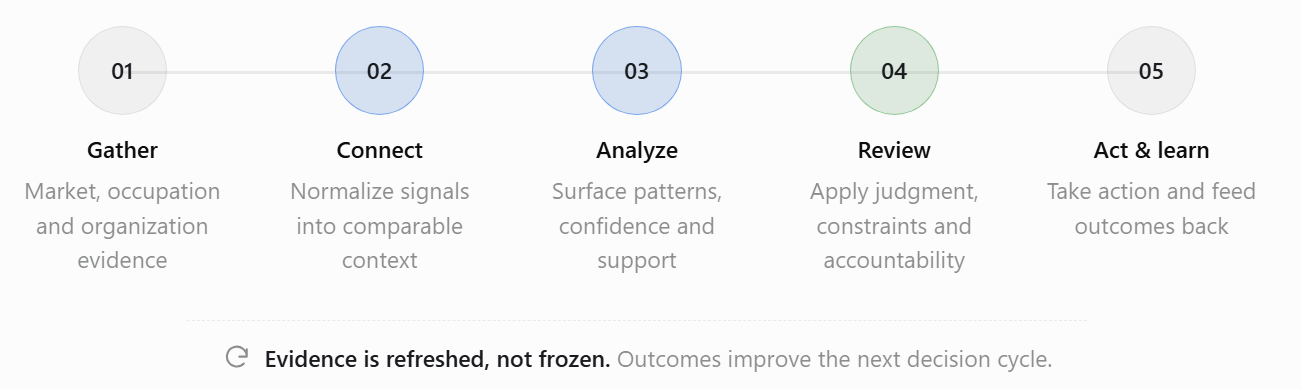
Decision lifecycle
Section titled “Decision lifecycle”Avelin supports a practical sequence:
1. Define the decision
Section titled “1. Define the decision”Start with one clear decision intent:
- define a hiring intake outcome,
- evaluate a role redesign,
- prioritize workforce planning scenarios,
- or compare reskilling options.
Avoid broad or mixed questions that do not map to a single workforce decision.
2. Gather relevant evidence
Section titled “2. Gather relevant evidence”Choose the current endpoint or controlled-beta workflow that exposes the evidence needed for the decision:
- role text and workforce input,
- occupational reference context,
- labor-market signals,
- tenant-specific role frameworks and policies.
Not every endpoint combines all four categories. Do not treat one source type as final truth or infer a source that the response does not identify.
3. Preserve provenance
Section titled “3. Preserve provenance”Keep track of where each signal came from and what scope it applies to.
- shared references provide general workforce context,
- tenant evidence brings organization-specific expectations,
- request context binds the decision to the specific case.
Without provenance, review confidence drops and decisions become hard to audit.
4. Compare and reconcile signals
Section titled “4. Compare and reconcile signals”Avelin returns endpoint-specific structure that teams can use to inspect support and gaps. Grounded reports add customer evidence and source references; job-intelligence responses add confidence, uncertainty, ambiguity, weak-signal, and quality fields.
- strong support,
- missing context,
- contradictory signals,
- uncertainty or ambiguity indicators.
Where disagreement is present, flag it before any automation.
5. Expose confidence and uncertainty
Section titled “5. Expose confidence and uncertainty”Confidence is an endpoint-specific strength signal, not a guarantee. On job analysis, root confidence and per-result confidence have different meanings. Uncertainty, ambiguity, weak signals, and quality fields provide separate reasons to avoid unsafe automation.
Surface both in UI or workflow policy so downstream systems can apply thresholds.
6. Route material uncertainty to human review
Section titled “6. Route material uncertainty to human review”If confidence is weak or evidence conflicts, route to a qualified reviewer.
Avelin is not a replacement for human workforce judgment and does not execute final hiring outcomes.
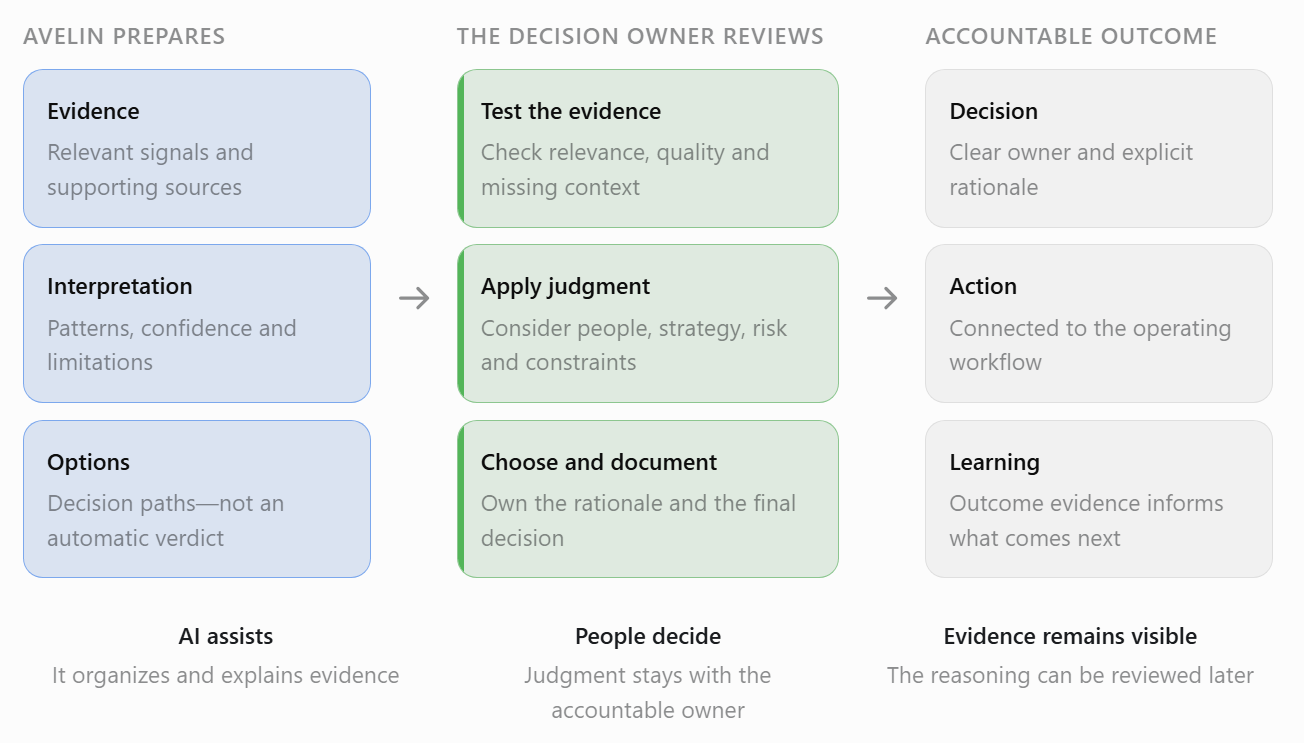
7. Record the basis for action
Section titled “7. Record the basis for action”For decisions that proceed, your workflow should record:
- selected evidence,
- limits and caveats,
- confidence and uncertainty context,
- and the review outcome.
Customer Grounding report and trace listings provide safe summaries for grounded decisions. Other endpoints do not create a general governance record on your behalf.
Examples built on current outputs
Section titled “Examples built on current outputs”The following are human-reviewed workflows that can consume current API outputs. They are not dedicated reskilling, role-redesign, or autonomous workforce-planning engines.
Workforce investment evidence review
Section titled “Workforce investment evidence review”For an enabled U.S. state, the controlled-beta Workforce Evidence Pack API can package selected SOC occupation evidence, separate NAICS industry-flow context, source lineage, limitations, and employer-validation questions into JSON and a standalone HTML report. It does not select occupations or make an investment recommendation. See the Workforce Evidence Pack API and executable lifecycle.
Hiring intake and role calibration
Section titled “Hiring intake and role calibration”A role intake often mixes related responsibilities.
Avelin can support the intake conversation with:
- occupation signals,
- skill evidence,
- weak-signal and ambiguity cues,
- and review guidance when the description is incomplete.
A reviewer can then ask targeted questions before advancing the role.
Workforce planning
Section titled “Workforce planning”When planning a capability shift or role model change, teams can use market context plus occupation structure to identify current evidence strengths and missing assumptions.
Avelin supports context-aware discussion, not autonomous workforce-planning execution.
Reskilling
Section titled “Reskilling”Reskilling decisions need clear evidence for transferability and required capability shifts.
Avelin outputs can help identify what skill evidence is strong, what is missing, and where additional business context is required before recommending any intervention.
Role redesign
Section titled “Role redesign”Role redesign can fail when hidden assumptions are not visible.
Use Avelin outputs to surface what changed in role expectations, where confidence is low, and where a framework-specific rule should alter the recommendation.
Common governance patterns
Section titled “Common governance patterns”- keep workforce decisions within documented policy,
- require human review on material uncertainty,
- avoid replacing business judgment,
- keep all assumptions in documented records.